
Blog
Thriving in Every Season of Parenthood

It’s easy to assume that coaching for moms is just about helping her feel better. And in some ways, it is. But what many families discover is that when a mom begins to grow, reflect, and learn new ways of thinking and communicating… the entire atmosphere of the home begins to change. Not because she forces everyone else to change. But because she begins to show up differently. And when the emotional leader of the home shifts, the ripple effect is powerful. Moms Often Carry the Emotional Climate of the Home Most moms I work with care deeply about the tone of their home. They want laughter in the kitchen. Conversations that feel connected instead of tense. Kids who feel safe coming to them with big emotions. But many moms are also carrying an invisible load. They are juggling schedules, expectations, school stress, sibling dynamics, extended family relationships, and their own inner dialogue about whether they are “doing it right.” When that load gets heavy, it often shows up as: Reacting quickly instead of responding thoughtfully Feeling resentful or unappreciated Nagging more than connecting Shutting down or feeling emotionally exhausted Not because they are bad moms. But because they were never taught the tools for navigating all of this. Life coaching changes that. Communication in the Home Starts to Shift One of the first things that begins to change is how conversations happen in the family. Instead of reacting from frustration, moms start learning how to slow down and get curious. They begin to model things like: Naming feelings instead of avoiding them Expressing needs clearly instead of expecting others to guess Listening without immediately correcting or fixing Repairing relationships when something goes wrong Kids begin to see that emotions are not something to fear or hide. They are something we can talk about and work through together. And that changes everything. Hard Moments Become Opportunities for Connection Life coaching doesn’t remove the hard moments of parenting. Kids still have meltdowns. Teenagers still get moody. Siblings still argue. But what changes is how those moments are handled. Instead of seeing difficult behavior as something that must be shut down immediately, moms begin to understand what might be happening underneath. They start asking questions like: What might my child be feeling right now? What does my child need in this moment? How can I guide this situation while staying connected? Children begin to feel understood instead of controlled. And when kids feel understood, they are much more willing to listen and cooperate. The Home Feels Calmer and More Grounded One of the most powerful shifts happens inside the mom herself. When a mom begins doing this work, she often experiences something many women haven’t felt in a long time: She begins to feel calm and confident again. Instead of feeling like she is constantly putting out fires, she begins to feel anchored. She trusts herself. She knows how to pause before reacting. She understands that her thoughts influence how she shows up. That grounded energy becomes the steady center of the home. Kids feel it. Partners feel it. Even the daily routines of family life start to feel lighter. Joy Returns to the Mother Who Leads the Home And perhaps the most meaningful change of all is this: Mom begins to enjoy her life again. Not because everything is perfect. But because she no longer believes that her happiness depends on everyone else behaving the right way. She knows how to support herself emotionally. She knows how to reconnect with her values. She knows how to show up intentionally instead of reactively. And when a mom begins living with that kind of clarity and joy… Her family gets to experience the best version of her. One Person’s Growth Can Change a Family It’s easy to believe that for family dynamics to improve, everyone has to participate. But the truth is, families are systems. When one person begins showing up differently, the system naturally shifts. Children learn emotional skills they will carry into adulthood. Partners experience more open communication. The home becomes a place where people feel safe being themselves. All because one mom decided to grow. And that kind of ripple effect can last for generations. Invitation If you’ve ever wished your home felt calmer, more connected, and filled with more joy, you’re not alone. And you don’t have to figure it out by yourself. This work isn’t about becoming a perfect parent. It’s about becoming a more supported, grounded, and confident version of yourself—which naturally changes the way your family experiences you. And sometimes, that’s where the real transformation begins.

Somewhere along the way, many of us picked up a quiet but heavy belief: Once I become a mom, I should know what I’m doing. That I should instinctively know how to respond with patience. That I should feel confident and grounded most of the time. That I should “arrive” at some version of motherhood where things finally feel steady. And when that doesn’t happen—when we feel overwhelmed, reactive, unsure, or stretched thin—we assume something must be wrong with us. But here’s the truth I want you to hear clearly: You were never meant to arrive. You were meant to learn. When I Thought I Should Be Good at This I worked incredibly hard to bring my sons home through adoption. There were classes. Trainings. Paperwork. Books. Research. Deep intention. By the time they came home, I truly believed I should be really good at motherhood. I had prepared. I had invested. I had wanted this deeply. And yet… motherhood still challenged me in ways I never expected. I was surprised by how often I felt unsure. By how much it stretched my patience. By how easily old patterns and reactions showed up—despite all the knowledge I carried. For a long time, that felt confusing and even discouraging. Hadn’t I done everything “right”? Motherhood Isn’t Mastery — It’s Becoming What I know now is this: preparation doesn’t eliminate growth. You can read the books. You can do the trainings. You can want this with your whole heart. And motherhood will still ask more of you. Not because you failed—but because this is how transformation works. Motherhood doesn’t hand us mastery. It invites us into a process. One that reveals our triggers. One that highlights the skills we were never taught. One that asks us to grow emotionally, relationally, and internally—right alongside our children. Learning Doesn’t Mean You’re Doing It Wrong So many moms carry quiet shame when things feel hard, especially when they’ve done “everything they were supposed to do.” But learning is not evidence of failure. It is evidence of engagement and love. The challenges I’ve faced in motherhood didn’t mean I wasn’t meant for this—they shaped me into the woman I was meant to become. Each stretch, each moment of reflection, each repair helped me grow into a more present, compassionate, regulated mom. Not perfect. But more intentional. And that growth didn’t just help me—it helped my children. You Are Becoming the Mom Your Kids Need There is no moment where motherhood suddenly feels finished or fully figured out. There is only becoming. Becoming more aware. Becoming more grounded. Becoming more aligned with your values. Becoming more compassionate with yourself. The very things that feel hard right now may be shaping you into the mom your children need—not despite the challenge, but because of it. You don’t need to have arrived to be a good mom. You just need to stay open. Open to learning. Open to reflection. Open to growth. And if no one has told you this lately, let me say it clearly: You’re not behind. You’re not failing. You’re becoming. If you’d like next, I can: Add a gentle CTA that invites moms into coaching or a discovery call Pull new quotes specifically from the adoption section Adapt this into a newsletter version or carousel captions This story is a gift—thank you for trusting me with it 💛

Let’s clear something up—because this misunderstanding keeps so many moms stuck. Peaceful parenting does not mean you let your kids walk all over you. It doesn’t mean you “stay calm” while your child runs the house. And it definitely doesn’t mean you avoid discipline because you don’t want your kids to be upset. Peaceful parenting isn’t weak. It isn’t passive. It isn’t permissive. In fact, peaceful parenting is one of the strongest, most intentional ways to lead your family. But because the word “peaceful” sounds soft, a lot of people assume it means parenting without boundaries, without consequence, and without authority. So if you’ve ever thought: “If I don’t raise my voice, will they take me seriously?” “If I validate their feelings, does that mean I’m giving in?” “If I don’t punish, how will they learn?” “Is peaceful parenting just… permissive parenting with nicer words?” You’re not alone. And you’re not wrong for wondering. But you deserve the truth. Why Peaceful Parenting Gets Misunderstood Many of us grew up with parenting styles that were either: Strict and controlling (“because I said so”), or Hands-off and permissive (“just do whatever makes you happy”) So when moms hear “peaceful parenting,” their brains often place it into the second category. But peaceful parenting isn’t the absence of leadership. It’s actually leadership without fear. It’s guidance without shame. It’s discipline without disconnection. Peaceful Parenting Is NOT Passive Parenting Passive parenting is when a mom checks out. It looks like: avoiding conflict at all costs not addressing disrespect because it feels exhausting letting things slide because “it’s not worth the fight” hoping behavior will improve on its own letting resentment quietly build And I say this with so much compassion, because passive parenting usually isn’t laziness… It’s burnout. Passive parenting often happens when a mom is depleted and overwhelmed, and she simply doesn’t have the capacity to hold boundaries anymore. But peaceful parenting is different. Peaceful parenting is when you stay emotionally regulated while still staying in charge. It sounds like: “I’m not going to argue with you, and the expectation is still the same.” “You can be mad, and I’m still saying no.” “This is hard. And you’re capable.” “I’m calm… but I’m not unclear.” Peaceful parenting is not weakness. It’s strength that doesn’t need to yell. Peaceful Parenting Is NOT Permissive Parenting Permissive parenting is when a parent avoids limits because they’re afraid of: conflict tears disappointment being the “bad guy” damaging the relationship Permissive parenting often looks like: too many warnings, not enough follow-through saying no… then saying yes after pushback negotiating everything overexplaining to the point of losing authority letting the child’s emotions determine the rules in the home And again—this isn’t about judging moms. Because most permissive parenting comes from something very tender: A mom who wants to do it differently than she was raised. A mom who wants her kids to feel safe. A mom who is trying to heal. But here’s the problem: When a child is in charge, they don’t feel safe. They feel anxious. Even if they act confident. Even if they act bossy. Even if they seem in control. Kids don’t need control. They need leadership they can trust. And peaceful parenting offers that. So What Is Peaceful Parenting? Peaceful parenting is: ✅ Warm AND firm ✅ connected AND boundaried ✅ emotionally safe AND leadership-centered It is the combination of two truths: My child’s emotions are valid. My child is not in charge. That’s the whole magic. Not “I validate so I give in.” But: “I can validate your feelings while still holding the boundary.” That’s what creates security. That’s what builds trust. That’s what teaches emotional resilience. A Peaceful Parent Still Has Boundaries This is where moms get confused. They think peaceful parenting means the goal is “never upset my child.” But peaceful parenting isn’t about avoiding discomfort. It’s about avoiding disconnection. Your child can feel upset. They can cry. They can slam the door. They can be disappointed. And you can still be a peaceful parent because you don’t match the chaos. You don’t become chaotic too. Instead, you become the steady one. Peaceful parenting sounds like: “You’re allowed to be mad. You’re not allowed to be mean.” “You can cry. And bedtime is still bedtime.” “It’s okay to feel disappointed. The answer is still no.” “I won’t let you talk to me that way.” “You don’t have to like this limit, but you do have to follow it.” That’s not permissive. That’s powerful. Peaceful Parenting Is Discipline With Connection A lot of moms have been taught: “If you don’t punish, they won’t learn.” But peaceful parenting teaches something even more important: Children learn best when they feel safe. Not indulged. Not controlled. Safe. Peaceful discipline focuses on: teaching modeling repair consistency emotional regulation clear expectations It says: “I will correct you without crushing you.” And that matters. Because shame might stop behavior temporarily… But it doesn’t teach a child what to do instead. Connection teaches. What Peaceful Parenting Looks Like In Real Life Let’s make this super practical. Scenario: Your child is yelling at you Permissive parenting: “It’s okay, honey, you’re just having big feelings.” Passive parenting: pretends not to hear or walks away and ignores it Peaceful parenting: “I will listen when your voice is calm. Try again.” Scenario: Your teen says something rude Permissive parenting: “He’s stressed. He didn’t mean it.” Passive parenting: lets it go but feels hurt for hours Peaceful parenting: “I understand you’re upset. You don’t get to speak to me that way. Let’s try again.” Scenario: Your child refuses to do what you ask Permissive parenting: bargaining, begging, overexplaining Passive parenting: gives up Peaceful parenting: “I hear you don’t want to. And this is still what needs to happen.” That’s leadership. That’s safety. That’s peaceful parenting. The Real Truth? Peaceful Parenting Is Mature Parenting I want to say something gently—but clearly. Peaceful parenting is not “nice parenting.” It is mature parenting. It takes emotional strength. It takes self-awareness. It takes intentionality. It requires that you learn to tolerate your child’s discomfort without panicking and fixing it. It requires that you stay rooted—even when the moment is loud. And that’s why peaceful parenting is so transformational. Because your child isn’t the only one growing. You are too. If You’ve Been Afraid Peaceful Parenting Would Make You “Too Soft”… Let me reassure you. You don’t need to become a pushover to be peaceful. You can be: gentle and firm loving and clear emotionally safe and strong calm and in charge And when you parent that way—consistently—your child doesn’t become spoiled. They become secure. Because they know: “My mom can handle my feelings… and she can lead our family with confidence.” Want Support Learning This in Real Life? If you’re a mom who wants to stop yelling, stop reacting, and stop feeling like you’re either “too harsh” or “too soft”… You’re exactly who I help. Peaceful parenting isn’t about perfection. It’s about becoming steady. And the best part? You don’t have to figure it out alone. If you’re ready to learn how to parent with calm leadership, clear boundaries, and deeper connection—book a 30-minute discovery call. Together we’ll map out what’s keeping you stuck and what it would look like to become the grounded, confident mom you know you are.

If you’ve ever felt like you’re “just getting through the day,” or swinging between shut-down numbness and explosive yelling, I want you to know this: You are not alone. You are not broken. And you are not a bad mom. I know this because I lived it. For a long time, my inner world and my outer world could not have looked more different. From the outside, it looked like we had a beautiful, thriving family — four kids (two adopted, two biological), a full life I had worked incredibly hard for. I had been a teacher. I knew kids. I should have been good at this. I thought I should love every part of parenting. I thought I should know how to handle every emotional outburst. I thought motherhood would feel like fulfillment, not frustration. But inside… I was unraveling. The Invisible Battle: Numbing Out vs. Explosive Rage I didn’t realize it at the time, but I was living in a constant state of overwhelm. And overwhelm has two escape doors: Numbing out… or raging out. Some days, I shut down. I went through the motions. Packing lunches, driving kids around, answering questions, breaking up arguments… but not feeling any of it. I was disconnected — from my kids, from joy, from myself. I remember taking all 4 kids to Disney World (my dream!) and standing there thinking "I know I should be enjoying this" but just feeling numb. Other days… the pressure exploded. The yelling surprised even me. I had always hated when people lost their temper. The sharp tone. The frustration that boiled over. The way I snapped at the kids I love more than anything over every little thing. One moment I was numb. - The next moment I was raging. And my kids? They never knew which version of me they were going to get. It wasn’t consistent. It wasn’t steady. And it wasn’t the mom I wanted to be. The Weight of “I Should Know Better” As a former teacher, the shame hit even deeper. “I should know how to do this.” “I should be more patient.” “I should be grateful.” “I asked for this—why am I so unhappy?” And behind all those thoughts was another one I didn’t want to admit: I am resentful. Resentful of the noise. Resentful of the demands. Resentful of the mental load. Resentful of needing to pour out constantly when I was running on empty. Especially as an adoptive mom, I carried guilt on top of resentment: “I worked so hard for this family… why do I feel this way?” “What is wrong with me?” Nothing was wrong with me. I was overwhelmed. Under-supported. Emotionally depleted. Running a marathon with a cup that was bone-dry. My nervous system was in survival mode — and survival mode does not create calm, connected parenting. The Moment I Realized: It Wasn’t My Kids… It Was My Emotional World One day, after another round of yelling followed by another wave of shame, I felt a truth rise up that I could no longer ignore: My reactions weren’t being caused by my children. They were being activated by something inside me. My emotional world was running the show. My past patterns were driving my present reactions. My triggers, my stories, my stress, my exhaustion — that was what was coming out in my parenting. And if the reaction was coming from within me… then I had the power to change it. That realization didn’t feel heavy. It felt like hope. The Slow, Steady Return to Myself Through deep personal work, nervous-system understanding, coaching tools, attachment science, and values-based parenting, something incredible began to happen: I came back home to myself. I didn’t become a perfect mom — but I became a present one. I learned to regulate. I learned to pause. I learned to repair. I learned to see my children’s behavior through a lens of connection, not conflict. I learned what I needed so I could stop expecting my kids to fill emotional gaps they were never meant to fill. And because I now love my life — truly love it — I can support my kids without needing them to make me feel okay. My relationship with them is deeper, steadier, and more intentional than ever. Not because they changed — but because I did. What I Want Every Mom to Know If you are numbing out… If you’re yelling more than you want to… If you’re inconsistent, overwhelmed, resentful, or ashamed… If you look like you have it all together but feel empty inside… You are not failing. You are overwhelmed. And that can be healed. You can feel calm again. You can reconnect with your kids. You can show up as the mom you want to be. You can love your life — not just push through it. I am living proof. Ready for Your Own Transformation? Join Me for The Steady & Connected Mom A 12-week path to calm, confident, connected motherhood — so you stop reacting from overwhelm and start living with purpose, presence, and joy. Inside our small group coaching program, you’ll learn: ✨ Emotional regulation ✨ How to stop numbing and stop yelling ✨ How to parent from your values instead of your triggers ✨ Tools for connection, communication, and confidence ✨ How to break old patterns and create new ones ✨ How to feel steady inside so your family can feel safe with you If this story felt familiar… If something inside you said, “This is me…” Then I would love to walk alongside you. DM me STEADY or click here to apply. Spots are limited to 10 moms. Your transformation begins the moment you say yes to yourself.

The body content of your post goes here. To edit this text, click on it and delete this default text and start typing your own or paste your own from a different source.
Every mom I know enters the holiday season with the same whispered hope: “I just want it to feel magical.” But somewhere between school concerts, extended family expectations, your own childhood memories, and the mental load of making everything special, you start to feel that familiar tug—overextension, resentment, pressure, and a version of you that doesn’t feel like the mom you want to be. Boundaries aren’t walls. They’re the framework that protects connection. Especially during the holidays. Why Holidays Challenge Our Boundaries The holidays are a perfect storm of triggers: Childhood patterns resurface (“We always did it this way…”) Family expectations get louder (“Can you host again this year?”) Internal pressure spikes (“Good moms should…”) Overstimulation is constant—for us and our kids Nostalgia pulls us into an idealized version of what it “should” be When moms don’t have clear boundaries, they typically respond in one of two ways: Over-functioning: Saying yes to everything, managing everyone’s emotions, keeping the peace at the cost of their own. Under-functioning: Shutting down, withdrawing, or snapping because the load is simply too heavy. Neither of these creates the connection we want with our kids during a season that’s supposed to feel meaningful. Boundaries are what allow you to respond from intention instead of overwhelm. What Healthy Boundaries Look Like During the Holidays Most moms think boundaries are about telling people what they can’t do. But real, functional boundaries are about what YOU will do to stay aligned with the mother you want to be. Here are holiday-specific examples that tie directly to the coaching work you do: 1. Time Boundaries: Protecting Your Presence Instead of: “I guess we’ll just squeeze it all in.” Try: “We’re keeping mornings slow this year so our kids can stay regulated. We’ll join after 11am.” This boundary honors everyone’s nervous systems—including yours. 2. Emotional Boundaries: Not Absorbing Others’ Stress Instead of: “I have to fix everyone’s mood.” Try: “I’m responsible for how I show up, not how everyone else feels.” 3. Expectation Boundaries: Redefining Tradition Instead of: “But we’ve always done it this way.” Try: “We’re creating new traditions that match the season our family is in.” 4. Physical Boundaries: Protecting Rest + Nervous System Capacity Instead of: “One more event won’t hurt.” Try: “We’re prioritizing downtime so we can actually enjoy the parts we say matter most.” How Boundaries Improve Family Dynamics When moms set boundaries, the entire family benefits. Kids feel safer Predictability and calm nervous systems feel like love to children—even if they protest the limits at first. Partners understand how to support you Clear needs help them show up with confidence instead of guessing. Extended family relationships become more honest You’re no longer performing. You’re connecting. You feel more like yourself More joy. More patience. More magic. Not because circumstances changed—but because you stopped abandoning yourself to make everyone else comfortable. A Simple Boundary-Setting Reflection for Moms (Use this as a tool or journaling prompt) 1. What do I want my kids to remember about this season? 2. What drains my energy the fastest during the holidays? 3. What helps me feel grounded and present? 4. What boundary would support the mother I want to be this year? Boundaries are simply the path back to your values. Closing Thought You don’t need a perfect plan to have a meaningful holiday. You just need permission to protect the moments that matter most. Boundaries give you that permission. When you hold them with clarity and compassion, you create a holiday experience that feels good not just for everyone else—but for you, too. The magic your family feels starts with the magic you’re able to experience. Ready to make this holiday feel calmer, lighter, and more intentional? Join me for The Magic Maker Reset on December 18 — a one-hour pause in the middle of the holiday whirlwind where you’ll reset your nervous system, reconnect with what actually matters, and create a simple plan to show up as the mom you want to be for the rest of the season. You already do so much for your family. This hour is for you — so the magic you create doesn’t come at the cost of your wellbeing. Save your spot today and step into the holiday you truly want to experience.
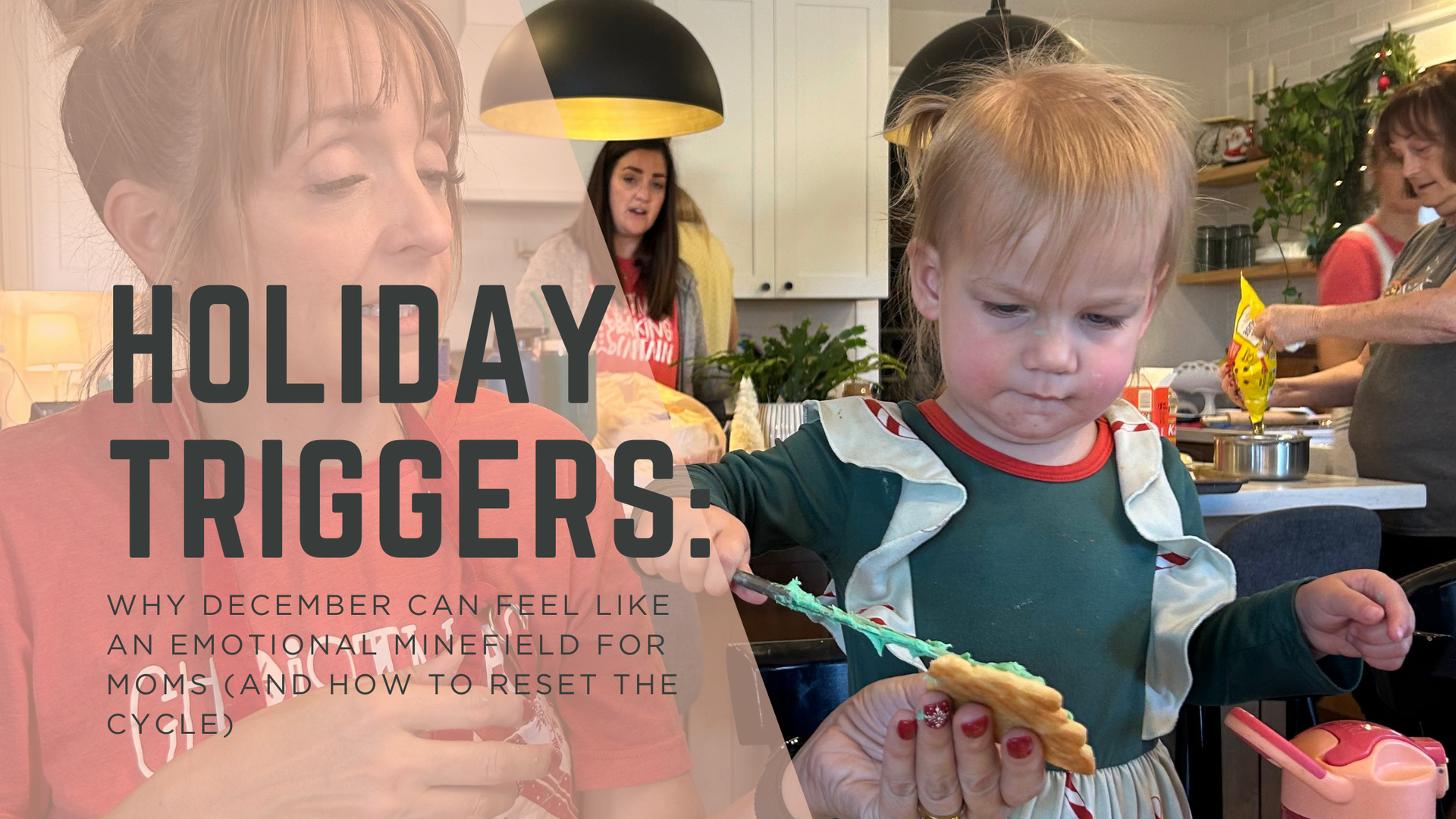
For many moms, December isn’t just twinkle lights and peppermint mochas. It’s a month packed with expectations — the kind that live quietly inside us until we’re faced with one more meltdown, one more to-do, or one more comment from a family member. And suddenly… you’re reacting in a way that doesn’t feel like the mom you want to be. The truth is: the holidays hold memories. Some magical. Some painful. And some we’ve carried into adulthood without even realizing they’re shaping how we show up now. This is where holiday triggers come in. What Actually Is a Holiday Trigger? A trigger is our nervous system saying, “This moment feels familiar… and not in a good way.” Like when: You’re doing everything to make Christmas magical and still feel unappreciated. The pressure to make everyone happy feels crushing. A family gathering brings up old wounds. Perfectionism takes the wheel and suddenly you’re snapping at your kids over crooked stockings. These reactions are rarely about what’s in front of us — they’re about what’s behind us. Common Childhood Roots of Holiday Stress If any of these feel familiar, you are not alone: ✨ You learned early that your worth came from making everyone else happy. So now, you hustle to keep the joy alive — even when it costs you yours. ✨ Your childhood holidays were chaotic or unpredictable. Today, one meltdown can send your body into survival mode — as if you’re 7 years old again. ✨ You were expected to behave, perform, or be “perfect” for appearances. So you carry the weight of “we must look like a happy family.” ✨ You felt unseen or unappreciated growing up. Now, when your family doesn’t gush over your efforts… it hurts deeper than you think. We pass down what we don’t heal — not because we’re bad moms, but because we are human moms. Signs You’re Caught in a Holiday Trigger Loop You’re constantly irritated or anxious You’re over-functioning while everyone else relaxes You feel resentful but don’t want to rock the boat You tell yourself “this is just how it always is” You end up being the martyr Santa (no fun, just jobs) If the holiday version of you feels stressed, snappy, or shut down… that’s a clue. How to Break the Cycle (Without Throwing Out Christmas 🎄) Here are three gentle practices to stop the unconscious passing of old patterns: 1️⃣ Name the Trigger When you feel your body tense or your patience disappear, pause and ask: “How old do I feel right now?” You might notice you feel more like a child trying to meet expectations than an empowered mom. Naming it takes away its power. 2️⃣ Choose One Thing That’s Yours A joyful holiday shouldn’t only exist for your kids. Ask yourself: “What would make this season feel nourishing for me?” ✨ A slower morning ✨ Saying no to one tradition ✨ Asking for help with wrapping ✨ Leaving a gathering earlier than usual You deserve joy too. 3️⃣ Rewrite the Moment in Real Time Holiday magic isn’t in perfection — it’s in connection. When you feel yourself spiraling: Breathe Get eye-level with your child or partner Say what you need instead of what you resent Small pivots protect your peace. Here’s the Truth You Need to Hear You are not failing. You are healing. And healing sometimes looks like frustration, tears, or a quiet 5-minute escape to the bathroom. Every moment you choose presence over perfection, you are rewriting your family legacy. Your kids won’t remember that you ran yourself ragged for picture-perfect holidays. They will remember the way your eyes softened… the way you laughed with them… the way you showed up as you. A New Holiday Intention Before the season sweeps you away, try grounding yourself with this affirmation: “I release the old expectations. I choose connection. I choose joy. I choose to show up as the mom I want to become.” That’s the kind of magic that outlives December. Ready for a Reset Before the Holidays Peak? If you’re reading this and thinking, “I don’t want to repeat the same holiday patterns again this year,” I’d love to support you. Join me on December 18 for The Magic Maker Reset, a one-hour live workshop designed just for moms who work so hard to make the holidays special, but often end up exhausted, overwhelmed, or feeling unseen. In this hour together, you’ll: Identify your biggest holiday triggers Get simple tools to stay calm and grounded (even when everyone else is melting down) Create a clear intention for how you want to show up for the rest of the season 👉 Sign Up Here Give yourself the same care and intention you pour into everyone else. You’re worth that reset. 💛
December can feel like a lot. Everywhere you look, people are posting cozy matching pajamas, smiling teens, perfectly decorated homes, and moments that look effortless and magical. And if you’re anything like most moms I talk to, you feel the pressure to make the season meaningful, peaceful, and special… all while juggling everything else life is throwing at you. Then your teen wakes up moody. Or snaps at you. Or rolls their eyes at the family movie night you tried to plan. Or your toddler is throwing a fit over wanting another piece of candy. And suddenly, all that pressure hits a little harder. You start wondering: “What am I doing wrong?” “Why does this feel so heavy?” “Why can’t we just have a normal, happy December?” If this is you, let me gently tell you something important: You’re not failing. You’re carrying more than you realize. Most moms don’t talk about the emotional load they carry in December: Keeping traditions alive Managing expectations Navigating extended family dynamics Trying to create memories Feeling responsible for everyone’s happiness And doing it all while your teen’s emotions swing from excited to overwhelmed in 30 seconds flat It’s a lot. And none of it means you’re doing anything wrong. Moms of teens hold a unique tension this time of year: You’re trying to savor moments that feel like they’re slipping away, while your teen is trying to figure out who they are and how to navigate their own swirling emotions. Their moodiness isn’t a sign you’re failing. It’s a sign they’re human — and developing — at the exact same time you’re trying to hold everything together. My Holiday Moment That Didn’t Go as Planned A few years ago, I had my own “not-so-magical” moment. I had this picture in my mind: a beautiful morning of opening gifts together. I had been planning each child's gifts for weeks and this was the moment. Music playing. Warm, connected, Hallmark vibes. Instead… my teen was obviously irritated about something after opening all of their gifts and snapped at me, then walked right back to their room. I felt the sting. I felt unappreciated. And if I’m honest, I reacted out of that hurt (and a little pity party for myself) I matched their tone, then spent the rest of the day frustrated — at them and at myself. But here’s what I learned: I was tying too much of my emotional world to their emotional world. I was trying to create a perfect moment instead of creating a steady one. I was letting their mood tell me something about my worth as a mom. And that was the shift I needed. ⭐ Three Tools to Stay Calm When Your Teen’s Attitude Spikes Here are three simple tools that have changed everything for me and the moms I coach: 1. Pause before you respond. Just three seconds. A breath. A moment to ask yourself: “Is this about me or about them?” Almost always… it’s about them. 2. Name what’s true. Not the story your mind jumps to. Not the fear spiral. Just the truth. “My teen is having a moment. I can stay grounded.” Truth steadies your nervous system. 3. Model the emotion you want to lead with. Calm. Curiosity. Compassion. Confidence. Your steadiness sets the tone. Even if they don’t match it right away. ⭐ What If This December Looked Different? Not perfect. Not magical. Not Instagram-worthy. Just grounded. Connected. Steady. What if instead of chasing moments… you became the woman who brings calm into them? What if instead of feeling tossed around by your teen’s emotions… you felt anchored in yourself? What if the holidays didn’t rely on your teen’s mood — but on your own emotional steadiness? That’s the work I do with moms of teens inside my 12-week coaching program, Steady & Connected. And if you want January to feel less overwhelming… if you want to start the new year feeling grounded, confident, and more connected with your family… ⭐ I have a few spots opening for moms who want to begin in January. If you’re curious whether it’s a fit, or just want to talk through what’s going on in your home right now… Click here to book a free discovery call or send me a DM with the word JANUARY. You don’t have to navigate this season alone. You can become the steady, joy-filled woman your teen feels safe with — even in the messiness of the holidays.

A mom in my coaching program shared a moment that stopped her in her tracks. She watched her teenage daughter leave the room in tears after an argument over holiday plans, and the heavy sound of the bedroom door closing felt painfully familiar, feeling disrespected she yelled at the closed door. In that instant, she wasn’t watching her daughter — she was suddenly 14 again, reliving a holiday memory she had sworn she’d never repeat. Same tone. Same tension. Same ending. She returned quietly in her kitchen, surrounded by pumpkin pie and half-set tables, and thought: “I promised myself our holidays would feel different. How did we get here?” Maybe you’ve had a moment like that too — especially around the holidays, when everyone is together, emotions run high, expectations feel heavy, and old family patterns show up like uninvited guests. The truth is, none of us enter motherhood as blank slates. We carry the blueprint of the homes we grew up in, and without intention, that blueprint becomes the default script of our current families. With Thanksgiving just days away, it’s the perfect time to pause and ask a powerful question: Are the relationships with your life partner, parents, siblings, and extended family aligned with the relationship you hope to have with your children someday? This is not about blame or perfection. It’s about awareness — and awareness is the doorway to change. Why It Matters More During the Holidays Our children are watching us this week more closely than we realize. They watch: How we speak to their grandparents How we handle interruptions and disagreements How we set boundaries or people-please Whether we rush and resent, or slow down and connect Whether we repair after conflict or sweep it under the rug They learn what relationships look and feel like by watching us live them — especially in moments of stress, togetherness, and tradition. The way we show up this holiday season is part of the legacy we are building. It’s the rehearsal for the relationship we will one day have with our adult children around holiday tables of their own. A Moment to Reflect Before the Table Is Set Before the turkey goes in the oven, before the guest room fills, before extended family arrives with opinions and emotional history… take a moment with these questions: With your life partner: How do we want to support each other this holiday? How can we repair quickly if tension rises? With your parents: What patterns do I want to continue? Which do I want to gently release? How do I want to feel when I say goodbye? With siblings or extended family: How can I hold healthy boundaries without guilt? How do I want to show up — grounded, patient, loving? With your children: What memories do I want them to take with them? How do I want them to feel in my presence this week? With your future self: When my children are grown and come home for the holidays, what kind of connection do I hope we’ll have? Let that vision guide everything. Choosing Intention Over Default Many women carry the quiet belief: “The holidays are always chaotic and stressful. That’s just how it is.” But here’s the truth: You get to decide what changes. Generational transformation begins with one intentional choice. That might look like: A pause before reacting A boundary said with love instead of fear Saying “thank you” or “I’m sorry” first Making space for rest and presence instead of performance Choosing connection over perfection Small shifts become powerful legacy shaping moments. Imagine Your Future Thanksgiving Table Close your eyes for a moment and picture it: Your children, now grown, choosing to come home because it feels safe, warm, seen, and peaceful. They laugh in the kitchen with you. They tell you things that matter. They trust you with their hearts. They stay longer because it feels like home. That future begins now — in the way you show up this week. You are not just preparing a holiday dinner. You are preparing the atmosphere of generations. And that is sacred work. You Don’t Have to Do It Alone If you’re ready to build family relationships rooted in emotional stability, respect, and connection — and to rewrite patterns that no longer serve your family — I’d love to support you. Steady & Connected: A 12-Week Journey for Moms of Teens A coaching experience designed to help you: Rewire emotional patterns and triggers Build deeper connection with your teens Strengthen relationships throughout your family system Create the legacy you want your children to inherit Become grounded, confident, and present This holiday season is your chance to choose your future. Let’s rewrite the story — together. A Thanksgiving Blessing to Carry With You May your home be filled with warmth instead of pressure. May your conversations be guided by curiosity instead of fear. May your presence matter more than your performance. And may this be the year you begin creating the legacy you dream of — one loving choice at a time.

If you feel like simply getting out the door on time (tie your shoes… where’s your coat… do you have your lunch??) is a battle, the reality is that you are locked in a power struggle with your child.